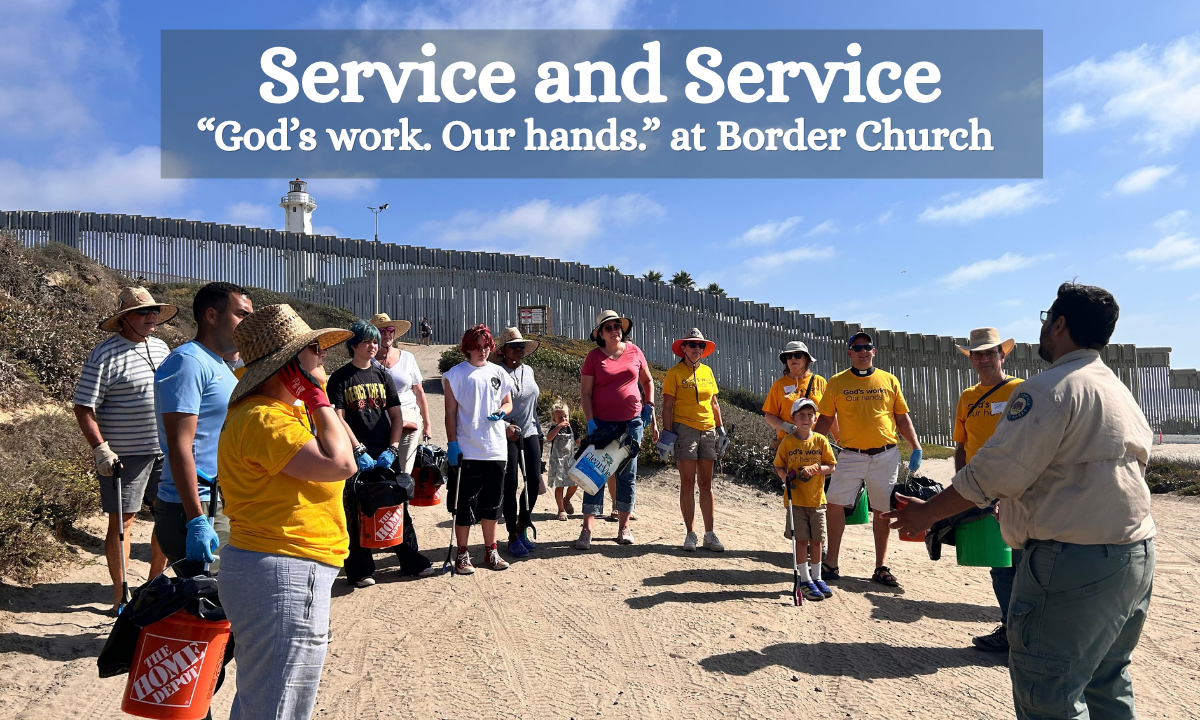
“God’s work. Our hands.” began in September 2013 as a dedicated day of gospel-oriented service across the ELCA. Thirteen years later, in 2026, for the first time ever, it came to the border.
Compelled to share the love of God in practical ways, eight congregations from the San Diego area met at Friendship Park, on the United States side of the border between the US and Mexico, for a beach cleanup, some letter-writing, a worship service, and a meal together.
“This is exactly what we want at the Border Church,” said Rev. Manuel Retamoza, pastor of Border Church. “We want people to gather together for worship, for a meal, to serve, to be with one another. Right now we can’t do that through the wall, but we can do it on either side of the wall.”
Border Church meets regularly with two congregations on either side of the border wall, one in the US and one in Mexico. The worship service begins with the congregations greeting one another via WhatsApp and praying together and blessing one another before moving on to individual worship services.
But this Sunday was different, as over 70 volunteers gathered for the various activities.
“It was fabulous to have a service project that was big enough or everyone,” said Rev. Bekki Lohrmann, pastor at St. Peter’s By the Sea Lutheran Church. “You know how sometimes people show up and there isn’t enough to do? Well that beach had plenty of litter to clean up and it could easily become a weekly service project!”
“The beach is just wide open, there’s rarely anyone using it, and the trash washes up during the high tides,” said Rev. Retamoza. “One of the highlights was being able to get up in between the walls; there’s a lot of trash there that never gets picked up because Border Patrol doesn’t allow people in there, but I talked to the Border Patrol guard and they let us in there in our bright yellow shirts to pick up the trash. We picked up two 50-gallon bags’ worth of trash in about 15 minutes.”
To make sure the day maintained its focus on gospel-oriented collective action, it also included a worship service led by various pastors from the gathered congregations.
“Participating in worship with Border Church is especially meaningful,” said Rev. Kinndlee Lund, pastor at Christ Lutheran Church, Pacific Beach. “Seeing the wall in person—which is actually two walls with a hazardous ‘no man's land’ area between them—looming over the border with its huge pillars topped with razor-wire fencing is so much more shocking than any clip you see on the news. Lifting up our hands toward the wall on this ‘God's work. Our Hands.’ Sunday and praying a Prayer of Confession about how we continue to divide and harm one another, and then hearing God's Promise of Forgiveness, was deeply moving in a way far different from praying and hearing those words in the comfort of our sanctuaries.”
“One woman from my congregation said that it was her first time to the border wall, and she said she needed to see it,” said Rev. Rick Fry, pastor at Ascension Lutheran Church. “It was a shock and lament for many to see the wall up close. The barbed wire, rust, and the surveillance tech all made it feel like a prison. We could only wave and barely see those who had gathered for worship on the other side.”
Another act of service came from those who wrote letters to immigrant detainees in the nearby Otay Mesa Detention Center.
“We had someone supervise to share what to say and what not to say and even to draw pictures just to put some art in their lives and give them something to look at other than the walls around them,” said Rev. Retamoza. “The whole messages are to let them know they’re not alone. Whether it’s writing or an image, we let them know we’re thinking of them and praying for them.”
“I found writing a letter to a person detained in Otay Mesa Detention to be meaningful,” said Rev. Fry.
One important facet of the day was the “love feast,” the time when everyone gathered back together to share a meal of homemade carne asada, pollo asada, rice, and beans. Though common for the regular Border Church gathering on the Mexican side, this was the inaugural love feast on the US side.
“This was the first time we were able to have lunch together on the US side,” said Rev. Retamoza. “That was important to me because it’s the model. That’s what the first Christians did, and so now that’s what we did for the first time on the US side. Modeling both what the early Christian church did and what they do on the Mexican side.”
All told, the day held lots of avenues for service and for follow-up exploration for future service, to gain a vision for a hopeful future for our world in general and this part of it specifically.
“It was the first time I’d taken our kids to the border that my eight-year-old can remember and it opened up so many conversations…about walls, about migrants, about welcome and about God,” said Rev. Lohrmann. “My kid loves nature and so the beach cleanup was a major hit for him and we had all kinds of conversations about climate change, care of creation, and the importance of our natural world.”
“Friendship Park is designed for this kind of gathering,” said Rev. Retamoza. “It used to be a shared space where families could gather, and so that’s what we’re about, is family reunification. We hope for a day when families can once again gather at the border and greet one another and share together.”



.png)
.png)
.png)
.png)
.png)