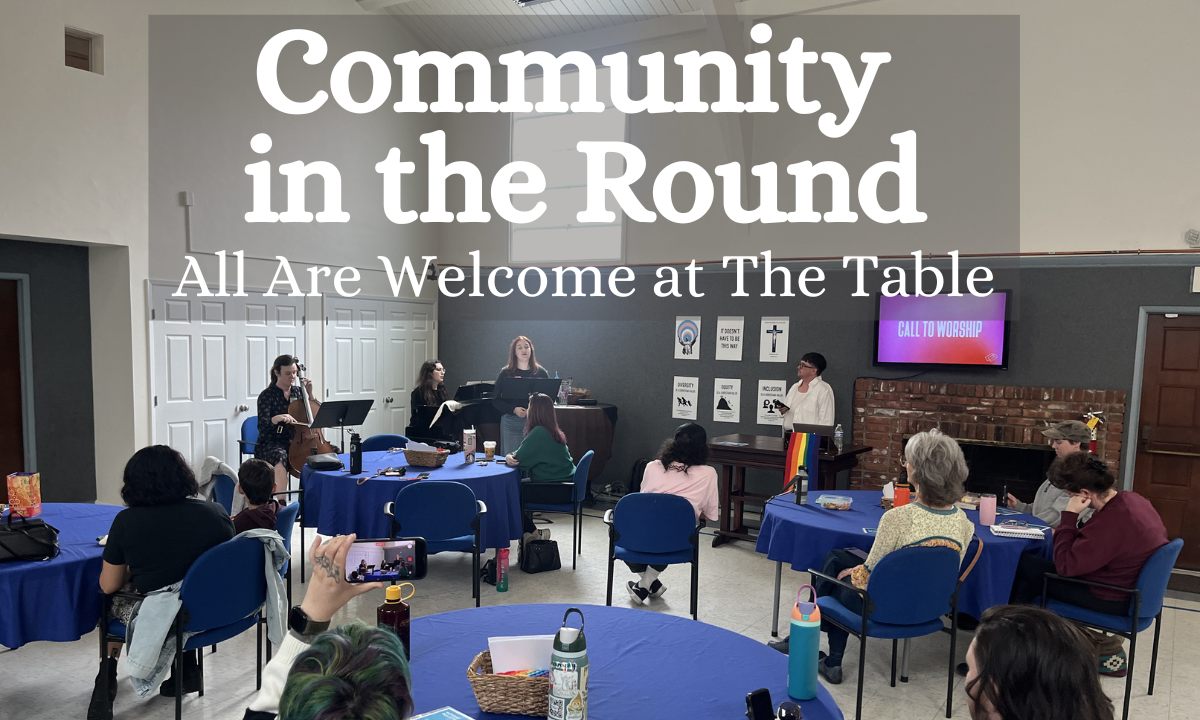
Worship has long had the Table as its centerpiece. But one community in Fullerton, California, is taking that concept literally.
It’s a church called The Table where, yes, the worship service concludes with communion. But that’s not all. Everything—peace, prayer, homily; the entire liturgy—is centered around a round table, creating an inclusive environment that encourages all to participate and to bring as much or as little of their entire selves as they’re willing.
Jaz Bowen-Waring, pastor of The Table, refers to this style of worship as “holy conversations.”
“Holy conversations is something that Martin Luther did with his table talks with his students,” Bowen-Waring said. “It’s a type of lectio divina, where the word of God becomes enfleshed and alive in our experiences with each other, when we bring our own experiences and wrestle with them together in community, that God sits among us.”
It is that kind of community and welcome that has made The Table a home for many people whose previous church experiences run the gamut of pain, loss, and trauma.
“The Table is a space for people who specifically have been marginalized from the church,” Bowen-Waring said, “or who are trying to find a space to wrestle with their faith in response to coming from high-control religion.”
“This is a space that has been truly safe and healing, and it’s something I’ve been grateful for,” said a congregant named Savannah, who has been attending The Table for almost five years. “The community keeps me coming back. There’s no pressure of how I need to show up.”
A congregant named Carly has story with unfortunate resonance among a lot of other Table congregants, as well as many other “exvangelicals.”
“I grew up evangelical,” Carly said. “I did missions trips, camps, was a youth group leader, went to a private Christian university. And then I came out as queer and lost a whole bunch of friends and a whole community.”
Carly embarked on a relationship with Rachel, an infrequent visitor to The Table, who invited Carly to visit. “I came the first time and was, like, ‘Oh, this is it. This is my new community,’” Carly said. “This is the first church-type space where I haven’t had a full panic attack. I feel safe and seen here.”
Another congregant, James, felt the same way upon first visiting The Table five years ago.
“Even though The Table is small, it’s a very vibrant community,” James said. “I realized when I started going here that I missed going to church and having that specific connection to somewhere.”
James especially appreciates the free-form vibe of the holy conversation-style of worship.
“I like the [discussion-based] approach here, how you aren’t being talked at,” James said. “Everyone comes and has some pull in how it goes.”
The worship is, indeed, radically participatory and inclusive, embodying liturgy as the work of the people. And though the format harkens back to the time of Martin Luther, the expression is uniquely modern. Bowen-Waring shared a brief homily using notes they read from their phone. There is no worship bulletin—congregants scan a QR code placed at each table. And the only music was from a trio that performed the Taylor Swift song “marjorie,” its lyrical theme “What died didn’t stay dead” proving an apt refrain for the Sunday after Easter.
It all works for a thoroughly engaged, literate, and thoughtful congregation, whose diverse perspectives during the conversational times made for rousing, reflective insights.
“It’s pretty unorthodox and open,” Bowen-Waring said. “There are a lot of differences in opinion, but there’s always just a lot of heart in people genuinely wanting to care for each other and create a better world.”
A variety of viewpoints that combine for a satisfying, nourishing whole. Sounds pretty appropriate for a place called The Table.



.png)
.png)
.png)
.png)
.png)